
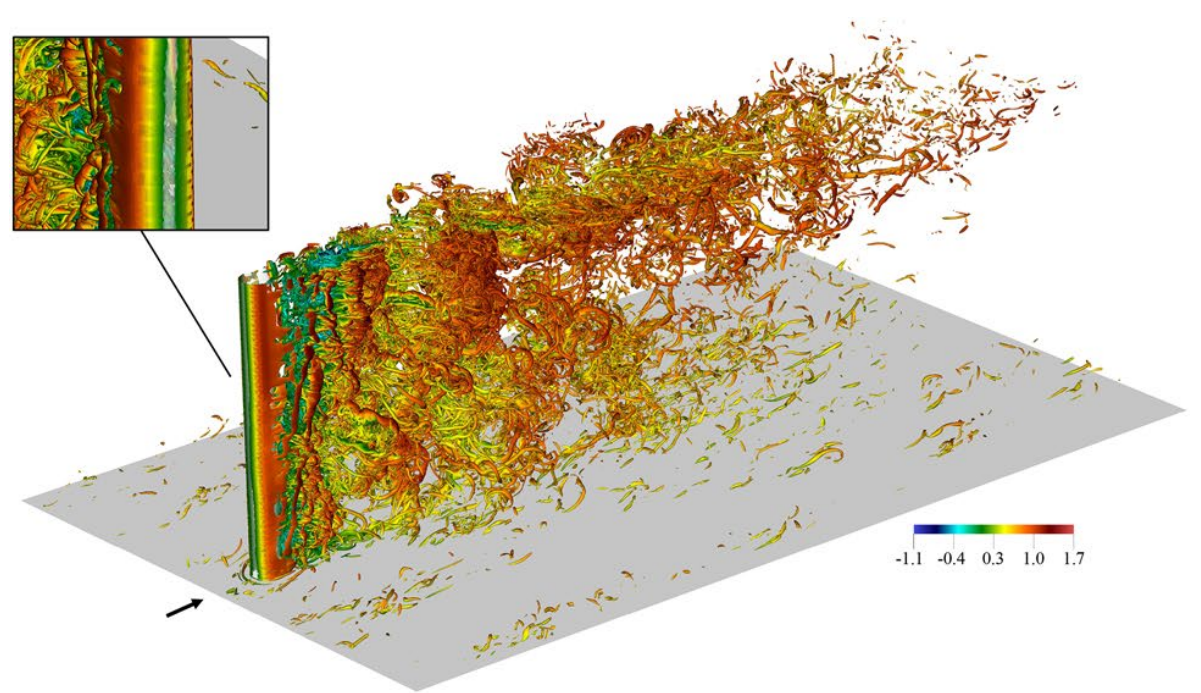
Background: Turbulence is of great scientific and industrial interest, finding its applications in automotive, climate and energy sectors. Along with experiments, scale–resolving turbulence simulations have contributed substantially to our understanding of physics and modelling of the phenomena. Yet the increasing spatial and temporal scales at high Reynolds also bring computational challenges, requiring advanced computational methods. Together with our collaborators, we exploit modern software and hardware capabilities to address this challenge. Our high–order spectral element solver Neko (Jansson N., et al. 2024) is purpose built in modern Fortran to take advantage of heterogeneous computing systems (e.g. GPGPUs) as well as traditional multi–core processors. Our optimized PySEMTools (Perez A., et al. 2025) code supports post–processing of spectral element data while being easy to master. We propose projects that help students gain hands–on experience with computational fluid dynamics (CFD), open source solvers and high performance computing (HPC). We would be happy to discuss and adjust the projects based on your background and targets.
Figure: Massaro D., et al. 2024
Projects:
- Direct numerical simulations in bends / ducts with Neko
- RANS simulations of wings / double–wings in OpenFOAM
- Reduced order modelling (e.g. POD, DMD) using PySEMTools.
- Symbolic computations for complex turbulence statistics and budget equations.
Specific tasks:
- literature review on the chosen topic;
- installing and running initial cases to understand code structure;
- setting up your new case, validation and final simulations in HPC systems;
- data analysis and reporting of the results.
Requirements:
- already taken CFD 1 & 2 lectures;
- experience with Python and high–level programming languages C++ or Fortran;
- interest in high-performance computing (MPI, CUDA, etc.);
- experience with open source CFD codes (OpenFOAM, Nek5000, Neko) is beneficial.
- independent and disciplined working style.
Starting date: flexible
Supervisors:
Isa Mammadli
Chair of Fluid Mechanics
Research associates
Contact
Prof. Dr. Philipp Schlatter
Chair of Fluid Mechanics
Professors