
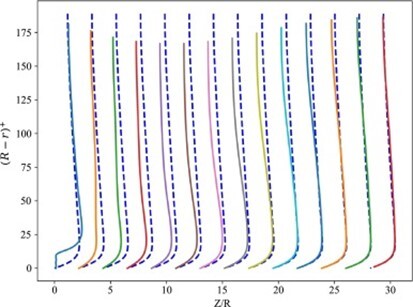
Background: When simulating turbulent flows, the specification of the inlet boundary condition is a crucial step, to ensure quick transition to a fully developed, healthy turbulence. In the literature there are different options, such as tripping, recycling, roughness, or the specification of synthetic turbulence. In this thesis work, we would like to translate and potentially improve a specific method, the so-called synthetic eddy method (SEM, Poletto et al. 2016) to our new GPU-based simulation code Neko. The figure shows how turbulence statistics develop for a turbulent pipe flow, as a function of downstream position. This is what we would like to also have in Neko, both using CPUs and GPUs.
With this thesis, you will have the unique opportunity to get insights into novel code development using a state-of-the-art simulation code, running on the largest computers (such as Jupiter in Jülich).
Massaro et al. 2024: https://doi.org/10.1016/j.cpc.2024.109249 (Section 3.3)
Poletto et al. 2016: https://doi.org/10.1007/s10494-013-9488-2
Specific tasks:
- Literature study on the topics of inflow turbulence
- Installing and running initial cases with Neko and Nek5000
- Understanding the implementation in Nek5000
- Porting the method to Neko, both on CPU and GPUs
- Simulations, data analysis and reporting of the results
Requirements:
- Experience and interest in high-performance computing and turbulence
- Programming experience in Python and/or Matlab
- Experience with legacy simulation codes (Fortran 77) is beneficial
- Independence working style
Starting date: Immediately
Advisor:

Prof. Dr. Philipp Schlatter
Chair of Fluid Mechanics
Professors